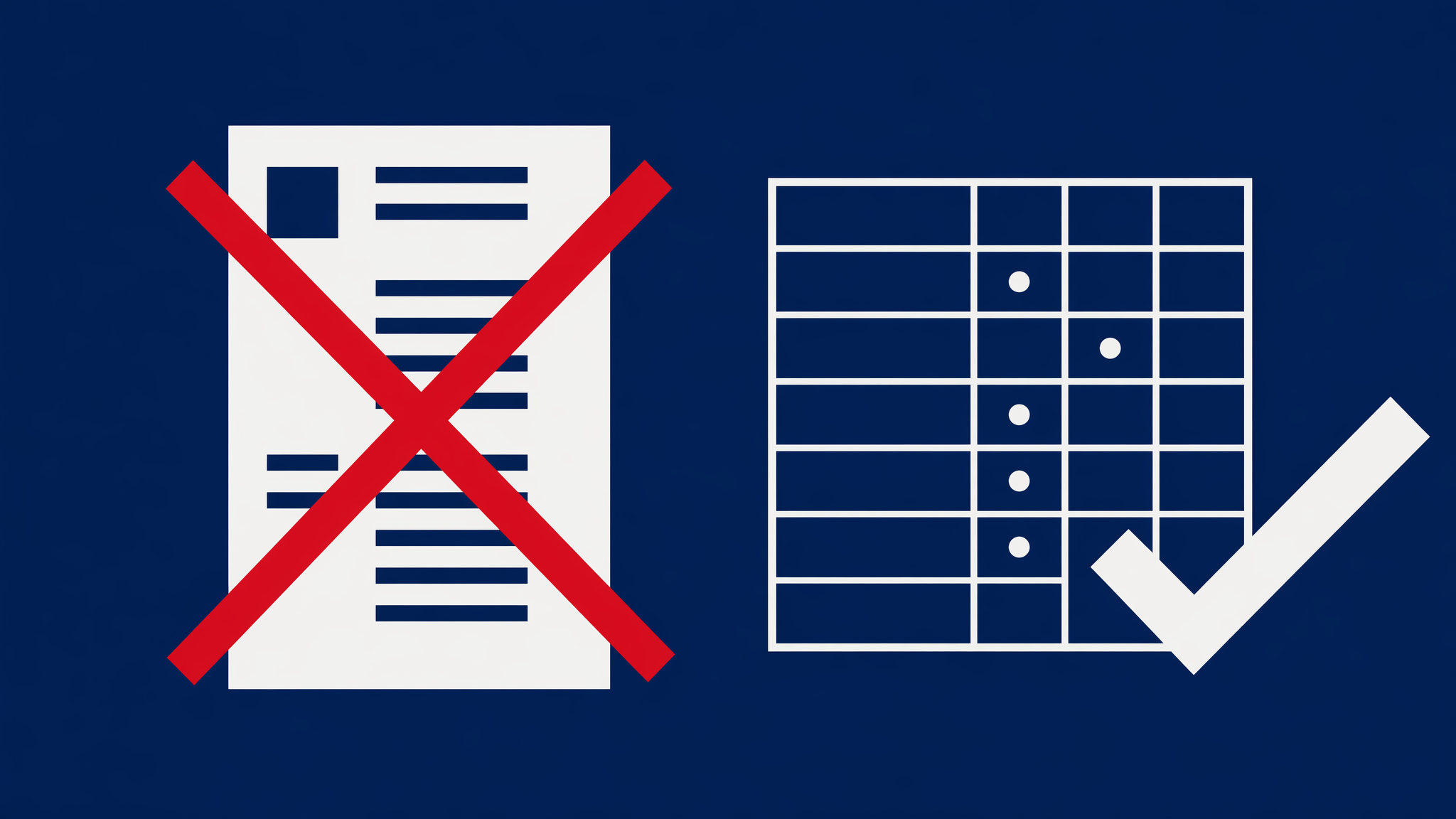
Hiring has always been a confidence game. You post a job, resumes pour in, and you filter by what looks right: the right schools, the right companies, the right number of years. It's fast, it's familiar, and it's wrong more often than anyone wants to admit.
In 2025, that gap between 'looks right on paper' and 'actually does the job well' has never been wider. Here's why — and what you should be doing instead.
The resume stopped being signal
The resume was always a proxy. It told you where someone had been, not what they could do. That was a reasonable trade-off when every application was written by a human and represented genuine effort. Today, 71% of candidates use AI to write or polish their resumes. The document you're reading was almost certainly optimised for your job description by a language model. It looks great. It says exactly the right things. And it tells you almost nothing.
At the same time, applications per role have roughly doubled since 2022. Recruiters are processing more documents than ever, with less signal in each one. The result is a screening process that's simultaneously slower and less accurate than it was three years ago.
Skills beat credentials — and the data backs it up
The research on what actually predicts job performance is settled. Work samples and structured interviews sit at the top. Years of experience and educational credentials sit near the bottom. Sackett et al.'s 2022 meta-analysis puts structured interviews at a .42 validity coefficient — roughly five times more predictive than resume proxies like education or job titles.
85% of employers now use skills-based hiring practices. 53% have formally removed degree requirements for at least some roles. The companies that moved early on this aren't doing it out of idealism — they're doing it because it works.
What this looks like in practice
At Umamy, we built the platform around this insight. Instead of asking candidates to convince you with a document, we put them through structured, AI-guided interviews that evaluate the actual dimensions that predict success in a given role. Consistent questions. Validated rubrics. Scores that compare candidates on the same criteria, not on how well they describe themselves.
The result: you see candidates your traditional process would have screened out, and you skip candidates who looked perfect on paper but interview poorly.
The compounding advantage
Here's the part that matters for founders and hiring managers specifically: this isn't just about individual hire quality. Every bad hire costs you 6–12 months of salary in lost productivity, recruiting costs, and team disruption. Improving your signal at the top of the funnel compounds across every role you fill.
The resume had a good run. It's time to replace it with something that actually tells you who can do the job.
Umamy helps founders and HR teams run structured, AI-powered interviews that surface the candidates who perform — not just the ones who write well.