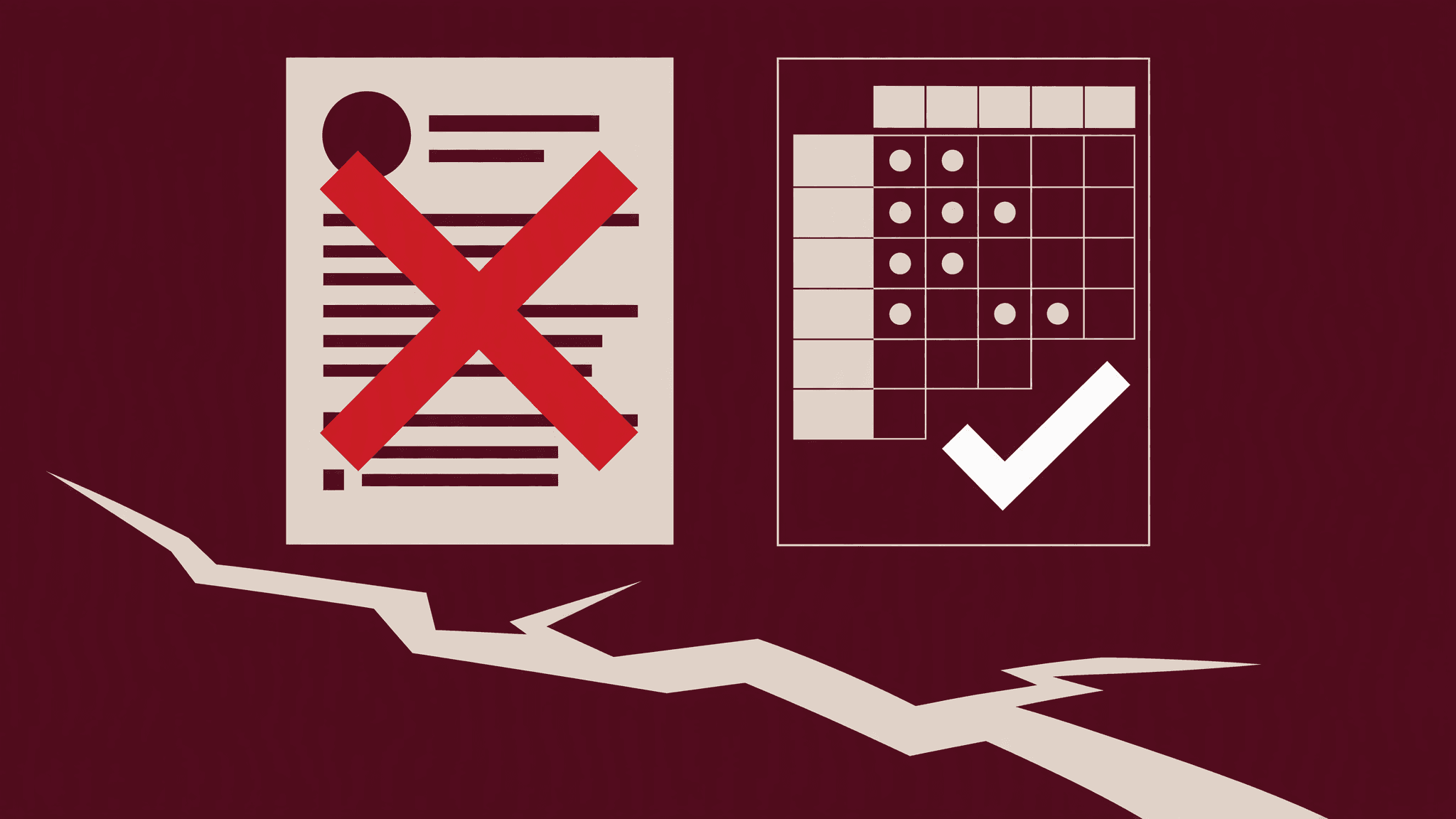
AI-written applications reviewed by AI screening tools don't surface the best candidates — they surface the best-optimised ones. A September 2026 controlled simulation tested eight models writing applications against six models evaluating them and found the loop rewards style over substance, undermining every promise skills-based hiring made.
Skills-based hiring was supposed to be the correction. No more degree-fetishism. No more résumé proxies for competence. You define the skills, candidates demonstrate them, and the bias gets crowded out by evidence. That was the pitch — and 70% of employers now say they use it for entry-level roles, up from 65% a year ago (NACE, 2026).
The problem is that the evidence pipeline is broken.
Why does AI-screening AI matter for skills-based hiring?
In 2026, most candidates use AI to write or heavily polish their applications. Most large employers use AI tools to screen those applications. The two meet in the middle — and when they do, something odd happens: the screening system doesn't evaluate skills. It evaluates how well the application text matches the patterns the screening model was trained to prefer.
A July 2026 comparison of automated skill-extraction methods found substantial differences in what systems identified as skills from identical résumés. Same person, same experience — different skill labels, depending on the tool. The résumé score is not a skills assessment. It's a style match.
The bias hides in the method, not the model
This is what makes the problem hard to see. When bias shows up in a human recruiter's judgment, it's visible and attributable. When an algorithm scores 10,000 applications a night, what looks like a consistent, objective process can still be systematically biased — but now the bias is wrapped in the authority of a number.
Research from the University of Maryland, covering more than 2,200 simulated résumés across 24 occupations, showed that varying only writing style or the order of equivalent skills changed outcomes without changing the underlying candidate. The scoring was consistent. The decisions were not neutral.
According to a 2026 Greenhouse report, only 21% of recruiters have strong confidence that their screening systems aren't filtering out qualified candidates. The other 79% suspect they are — and they're right to.
Skills-first doesn't work without a signal-first screen
The mistake is treating the résumé, even an AI-processed one, as a skills signal. It isn't. It's a document produced under the conditions of job hunting in 2026, which means it was written to pass a screen, not to describe a person.
Structured interviews and work samples survive this problem because they don't depend on the application document. A good structured interview — real behavioural questions tied to specific job performance criteria, scored against a rubric defined before the interview — produces evidence the screening layer can't contaminate. Lou Adler's performance-based approach ("describe your most significant accomplishment in this area") is blunt and hard to fake with AI assistance, because the follow-up questions drill into details the candidate actually lived.
Work samples are even cleaner: give the candidate the actual work, assess what they produce.
📄 Running structured interviews that actually surface skills? Download our practical guide to building scorecards, writing behavioural questions, and calibrating interviewers across a panel — before you start the next hire. Get the structured interview guide
What compliance is about to force anyway
The EU AI Act's transparency duties for AI hiring systems came into force on August 2, 2026. The high-risk obligations — documentation, human oversight, risk management for tools that filter or evaluate candidates — apply from December 2, 2027 (pushed back from August 2026 by the Digital Omnibus). Colorado's SB 26-189, signed May 2026, adds notice, disclosure, and mandatory human review for automated decision tools in hiring. New York City's Local Law 144 already requires annual independent bias audits.
The regulatory direction is clear: document your AI tools, demonstrate human oversight, and prove your screening isn't discriminatory. That's not achievable if you don't actually understand what your screening is measuring.
The companies who get ahead of this aren't waiting for the deadlines. They're auditing their stacks now — listing every tool that scores, ranks, filters, schedules, or interviews candidates — and replacing résumé-score steps with structured assessment steps where human judgment is recorded and defensible.
Umamy's approach: skip the broken layer
This is why Umamy is designed around founder-led and manager-led outreach rather than résumé screening. When a manager contacts a shortlisted candidate directly — via Alter Ego Sourcing, under their own name — the conversation starts with a human signal, not an algorithmic score. The Dynamic Fit Score that informs the shortlist is built on context enrichment and self-calibrating logic, not keyword matching. Candidates are sourced; they aren't filtered through the loop.
It's not a workflow improvement. It's a different model: 1 in 2 people contacted replies (sample of 11,010 people contacted). That response rate doesn't happen when candidates feel like they're feeding a machine.
📄 Want to see how the outreach model works in practice? Run a free hiring simulation and see your first shortlist in 10 minutes — no résumé pile required. Try the Umamy simulator
Frequently asked questions
Does skills-based hiring still work if candidates use AI?
Only if your skills signal doesn't come from the application document. Work samples, structured behavioural interviews, and performance-based assessments all produce evidence that isn't contaminated by AI-assisted writing. The skills-based approach works when it's anchored in direct assessment — it breaks when it's proxied through résumé text.
How do I audit whether my AI screening tool is biased?
Start by listing every tool that touches candidate evaluation. For each one: what does it score, and on what input? If the input is résumé text, run a variation test — submit identical experience with different writing styles and see what changes. NYC Local Law 144 requires annual independent bias audits for employers in that jurisdiction; that methodology is a reasonable model everywhere.
What does the EU AI Act require of hiring teams right now?
Transparency duties for certain AI systems have been in force since August 2, 2026. If you use AI hiring tools, candidates must be informed. The high-risk obligations (documentation, human oversight, risk management for filtering/evaluation tools) apply from December 2, 2027. Colorado's SB 26-189 is in effect from January 1, 2027 for US employers. Start the documentation now — the gap between "we use an ATS with AI features" and "we can explain what that AI decides and why" is where the liability lives.
Sources: NACE 2026 skills-based hiring survey · Greenhouse 2026 hiring confidence report · University of Maryland résumé variation study, 2026 (2,200+ simulated résumés, 24 occupations) · CEOWorld / The Undercover Recruiter, November 2026 · EU AI Act (Regulation (EU) 2024/1689), Digital Omnibus (Regulation (EU) 2026/1744) · Colorado SB 26-189, signed May 14, 2026 · NYC Local Law 144, enforced July 5, 2023